Psychology
Psychotherapy

We feed the psyche

Well-being first passes through the soul

How many times have we started a diet?
How many times have we lost weight to regain it shortly after?
How many nutritionists have we consulted without understanding that the problem lay elsewhere?
How many excuses have we come up with to justify a few binges?
How many feelings of guilt! How much demotivation!

... how many experiences should be reworked to turn the page ...

For these and other reasons, the Psychology and Psychotherapy department is active in our Medical Center.
Through innovative therapeutic approaches and short treatment Patchs, specialized personnel help people change their point of view on life and gain greater awareness of their own discomforts and potential.
This new inner awareness leads to overcoming the idea of "diet": a correct diet will be experienced as a conscious choice of love for oneself, no longer a sacrifice.
And this is the secret to making weight loss permanent.

Follow our doctors on YouTube

Services

The discomfort of those suffering from eating disorders should not be underestimated, but understood in all its nuances. For this reason, in Nutrizione Prevenzione there is a team of psychologists and psychiatrists who aim to build a Patch of self-care and self-development for the patient starting from the resources of the individual.

The services of psychology and psychiatry

Eating disorders are numerous and complex. In fact, alongside anorexia there are many forms of discomfort, perhaps less known, but equally problematic.
Often the eating disorder is only the tip of the iceberg of the discomfort that afflicts a person.
If they are not identified early and dealt with together with qualified and competent personnel, these disorders can become chronic and lead to a more complex and profound disease state, difficult to eradicate, which leads the person to a tiring and suffering existence

Urgent interventions for food behavior disorders

We don't always eat to satisfy our hunger.
Many of us use food to relieve stress, anxiety, sadness, loneliness or boredom, giving in to what is called 'nervous or emotional hunger'.
An already widespread disorder that has gone on to further increase since the beginning of the Covid emergency period.
In Nutrizione Prevenzione we treat this disorder by studying the cause that triggers nervous hunger and what are the behaviors to follow to control it, distinguishing it from physical hunger.

Help in case of nervous hunger

Medical Staff

Dr. Katia Colautti

  • Psychologist

  • Child and adult psychotherapist

She has gained extensive experience in the treatment of addictions, working across the Triveneto area.

She applies the imaginative technique of deep analysis and restructuring, which uses the human capacity to express psychological distress through images in order to foster change toward healing.

  • Degree in Psychology from the University of Padua
  • Specialized in Child and Adult Psychotherapy with Imaginative Techniques
  • Registered with the Friuli Venezia Giulia Board of Psychologists, registration number 782

Dr. Alessandro Rosolen

  • Psychologist

Behind our relationship with food, there is often much more than a question of nutrition or willpower: hunger, control or refusal can become the way the mind gives voice to emotions, tensions and experiences that cannot otherwise find expression.

Dr. Rosolen offers a protected, non-judgmental space for listening, in which the person can feel like the protagonist of their own journey, supporting them in exploring their personal dynamics to gain greater clarity about what they are experiencing. Together, they work to develop greater self-awareness, transforming suffering and confusion into an opportunity to regain balance, serenity and a new way of inhabiting life and the body.

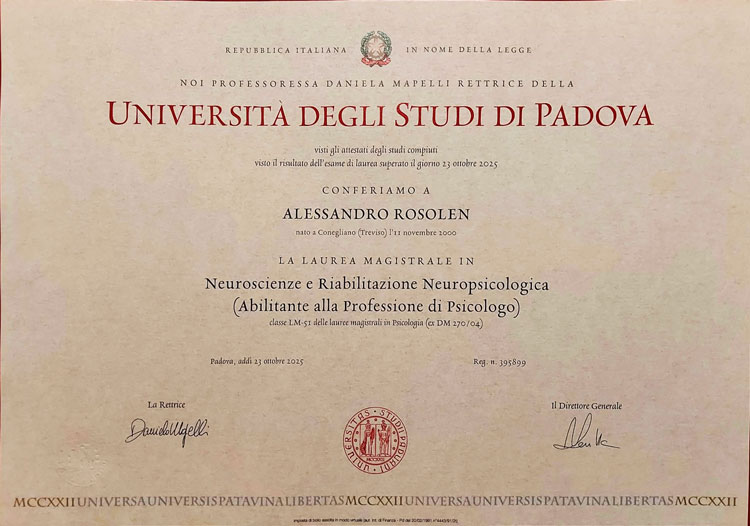
He earned his degree in Psychology, driven by a passion for the workings of the mind and human relationships, before going on to complete a Master's Degree in Neuroscience and Neuropsychological Rehabilitation (qualifying for the Profession of Psychologist) at the University of Padua. He is currently continuing his specialization training in Psychoanalysis, to gain a deeper understanding of the inner and relational dynamics that shape our experience.

  • Master's Degree in Neuroscience and Neuropsychological Rehabilitation (qualifying for the Profession of Psychologist) from the University of Padua